Use Cases of Deep Planner
Perform an Honest, Instantaneous Alignment between Product and Engineering
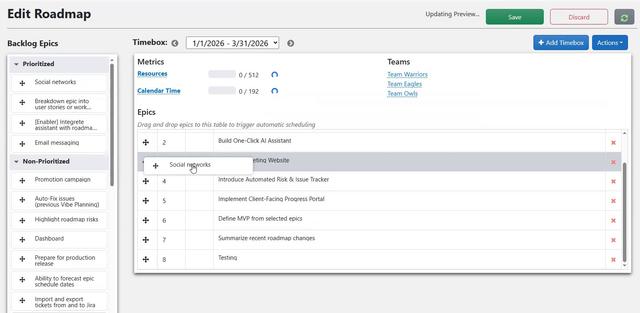
Generate a quick data-driven and balanced schedule prediction that will validate your business plan
Enter your features, high-level estimates, and teams to generate a risk-adjusted, resource-efficient and balanced schedule prediction.
Use the schedule prediction to provide realistic and high-quality quotes to your customers, stakeholders, and auditors, and align with engineering teams.
Modify user stories, change teams' configurations, and adjust feature ownership and priorities during scope negotiations.
Generate reports or share your schedule with a link for effective communication.
Perform Re-Alignment in the Execution Phase
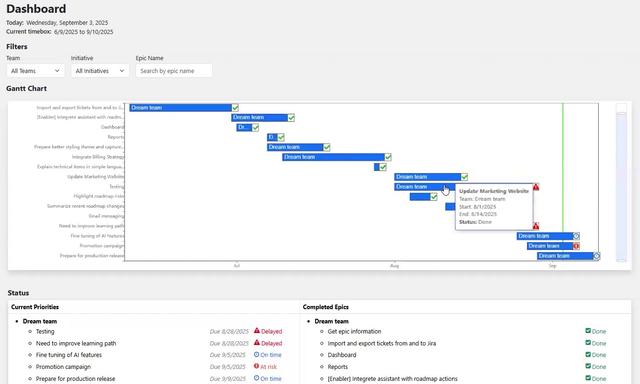
Make your plans dynamic: allow teams and stakeholders to track status and make roadmap updates in real-time, while adjusting the master plan.
Save all of the information about your roadmap, such as schedule predictions and building blocks, in a single place.
Building blocks include assumptions, scope, team capacities, high-level estimates, and dependencies.
Track schedule pieces back to the building blocks to recall and reuse the context of roadmap decisions for updates.
Oversee the roadmap dashboard, track progress by feature or initiative, and share it with your teams and stakeholders.
Synchronize with JIRA.
Q&A
Q: How is Deep Planner different from Jira Roadmaps, Smartsheets or Aha?
A: Deep Planner builds schedules automatically, based on an optimized algorithm. It is a predictive planning engine, not a static roadmapping tool.
Q: Is Deep Planner an AI wrapper?
A: No, Deep Planner is not an AI wrapper. The underlying algorithm is fully determinstic. It's based on statistics, mathematical modelling and the Theory of Constraints.
Q: How can I prevent the 'trash in trash out' situation with data?
A: We recommend to use historical data and numerous reliable estimation techniques that have been validated over time (like planning poker). You can provide level of uncertainty associated with each estimate and the system will use it as a risk factor.
Q: Can I assign feature ownership to individual teams or team members?
A: Yes, you can assign feature ownership to individual teams or team members. The algorithm will prioritize these assignments when generating the optimal schedule. You can also modify scope, team capacities, and other practical limits.